PTFE Braided Hose Manufacturing: Outer Braiding Process and Key Equipment
PTFE braided hose is widely used in industries that demand chemical resistance, temperature stability, and reliable pressure performance. While the PTFE inner tube provides excellent media compatibility, the outer braid plays a critical role in strengthening the hose, improving pressure containment, and protecting the core during service. Industry product literature commonly describes PTFE hose as a smooth or convoluted PTFE core reinforced with a stainless steel braid, most often in 304 or 316 grades. Some higher-pressure constructions also use two stainless braids rather than one.
For manufacturers and buyers, understanding the outer braiding process is important because the braid is not only a structural layer. It also affects flexibility, surface durability, burst resistance, and the overall service life of the finished hose. That is why the quality of the braiding process and the selection of the correct equipment directly influence final product performance. PTFE hose references from Swagelok and Polyhose specifically note that stainless steel braid is used to promote pressure containment and protect the hose core from external abrasion.
What Is the Outer Braiding Layer on PTFE Hose?
The outer braid is a reinforcement layer formed by interlacing metal wires around the PTFE inner tube. In many industrial hose designs, the braid is made from stainless steel wire because stainless steel combines strength, corrosion resistance, and heat resistance. This structure allows the hose to remain flexible while also handling internal pressure more effectively than an unreinforced PTFE tube. Product data from major hose suppliers frequently lists 304 stainless steel braid as the standard reinforcement, with 316 stainless steel available in some constructions for greater corrosion resistance.
For this reason, the braid is often one of the most important selling points of a PTFE braided hose. Customers may focus first on the PTFE liner, but in real operating conditions, the outer braid often determines whether the hose can perform reliably in high-pressure, high-vibration, or mechanically demanding environments.
How the PTFE Hose Outer Braiding Process Works
The braiding process starts after the PTFE inner tube has already been prepared. Depending on the product design, that core may be a smooth-bore sintered PTFE tube or a convoluted PTFE hose. The finished core is then fed into the braiding line as the base material for reinforcement. Industry product descriptions for PTFE hoses explicitly refer to both smooth-bore and convoluted PTFE cores used beneath stainless steel reinforcement.
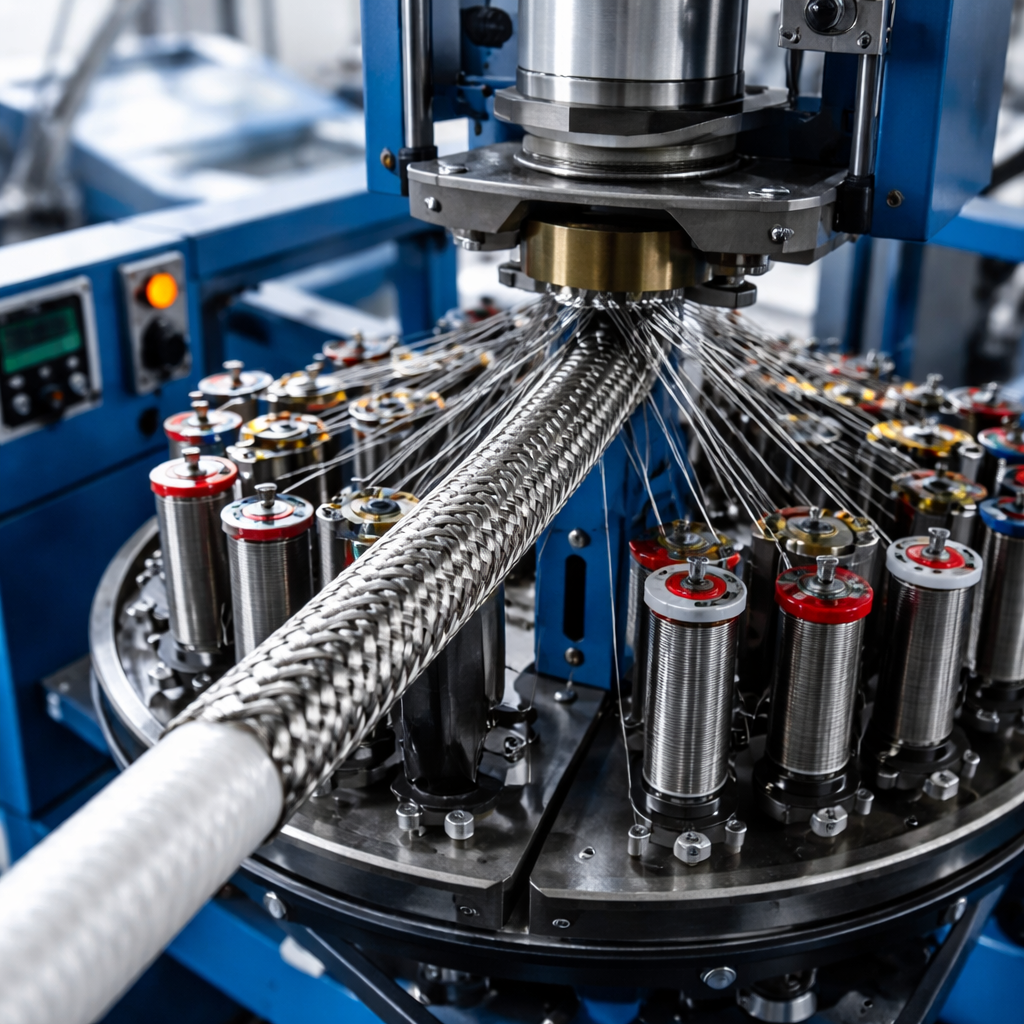
In production, stainless steel wires are first wound onto bobbins and loaded into the carriers of the braiding machine. As the machine runs, those carriers move in a controlled crossing pattern around the hose core, creating a uniform braid structure. Modern braiders from hose and cable equipment makers typically provide individual carrier tension control, which is important because stable wire tension helps maintain braid consistency and prevents loose or uneven coverage.
During braiding, the PTFE core passes through the center of the machine while the braid angle and pitch are formed by the interaction between carrier motion and the pull-off speed. Official braider specifications also highlight core centralizing units, gear-driven take-off systems, and capstan or caterpillar haul-off arrangements, all of which help keep the hose moving steadily through the braiding zone. In hose applications, equipment suppliers also note that even pull-off force and low-pressure treatment of the core material are important for stable production.
After braiding, the hose is collected on a take-up or winder. In many production lines, payoffs and takeups are coordinated with dancer control so the core material stays stable and tension remains reproducible. This controlled handling is especially valuable for hose products because it helps avoid twisting, over-pulling, or damage to the PTFE core during continuous manufacture.
Key Equipment Used for PTFE Hose Braiding
1. Stainless Steel Wire Braiding Machine
The main machine in this process is the wire braider, often called a hose braiding machine or maypole braider depending on design. Equipment suppliers such as Wardwell and Spirka list dedicated braiders for hose and tubing applications, including models designed for pressure hose reinforcement. These machines can be configured for wire carriers and are built to form consistent braid patterns around a moving core.
2. Payoff System
Before braiding begins, the PTFE tube and wire materials must be fed smoothly into the machine. Payoff systems support this step by allowing stable unwinding of the core and reinforcement materials. Spirka specifically lists payoffs as part of its accessory range for cable and hose braiding lines.
3. Take-Up or Winding Machine
Once the braid is applied, the finished hose needs to be wound without damaging the structure. Winding equipment handles this stage and helps maintain orderly collection for downstream fitting, testing, or packaging. Hose-industry braiding solutions from Wardwell and Spirka commonly pair braiders with dedicated winding equipment and take-up systems.
4. Haul-Off or Take-Off Unit
A stable haul-off unit is essential because it controls the forward movement of the hose core through the braiding area. Depending on the product size and reinforcement design, manufacturers may use capstan haul-off or caterpillar take-off systems. Wardwell’s hose-related braiding equipment descriptions mention both capstan and caterpillar haul-off solutions for reinforced hose applications.
5. Tension Control and Monitoring Devices
High-quality braid construction depends on stable wire tension and smooth core handling. Braiding equipment suppliers therefore emphasize functions such as individual carrier tension control, dancer-regulated payoffs and takeups, and wire tension monitoring. These control systems help keep the braid even and reduce defects during continuous production.
6. Detection and Safety Systems
Modern braiders may also include broken-end detection, empty bobbin detection, safety guards, and controlled acceleration or deceleration. These functions improve production stability and reduce downtime caused by wire breaks or operator intervention.
Why the Braiding Process Matters
A PTFE hose is only as reliable as its reinforcement structure. If the braid is too loose, uneven, or unstable, the hose may not achieve the expected pressure performance. If the wire tension is too high or the core handling is poor, the manufacturer may also damage the PTFE tube during production. That is why outer braiding is not a simple decorative layer. It is a precision reinforcement process that directly affects hose quality. The technical features highlighted by hose-braiding equipment makers—such as precise tension control, even pull-off force, and stress-free handling of the core—reflect this requirement.
In practical applications, the stainless steel braid improves pressure containment and protects the hose against abrasion. Some PTFE hose constructions also add a silicone outer cover, which manufacturers note can help reduce braid fraying caused by abrasion while also giving a smoother, easier-to-clean outside surface.
Applications of Braided PTFE Hose
Because of this reinforced structure, braided PTFE hose is widely used in chemical transfer systems, fluid handling lines, high-temperature industrial equipment, sanitary process systems, and demanding machinery installations. Suppliers market PTFE braided hose for applications where chemical compatibility, flexibility, pressure performance, and temperature resistance are all important.
For many customers, the value of braided PTFE hose lies in this combination: the PTFE liner handles difficult media, while the stainless steel braid gives the hose the mechanical strength needed for real industrial service. That is exactly why outer braiding equipment remains a critical part of PTFE hose manufacturing.
Conclusion
The outer braiding process is one of the most important manufacturing steps in PTFE hose production. It transforms a chemically resistant PTFE inner tube into a more durable, pressure-capable, and application-ready hose product. In most cases, this process uses stainless steel wire braiding machines together with payoff systems, haul-off units, take-ups, and tension control devices to achieve a stable and uniform braid.
For buyers, understanding this process helps them evaluate hose quality more accurately. For manufacturers, investing in the right braiding equipment is essential for producing consistent and competitive PTFE braided hose. If you want to build a reliable PTFE hose production line or source high-quality braided PTFE hose, the outer braiding process should always be a key focus.